
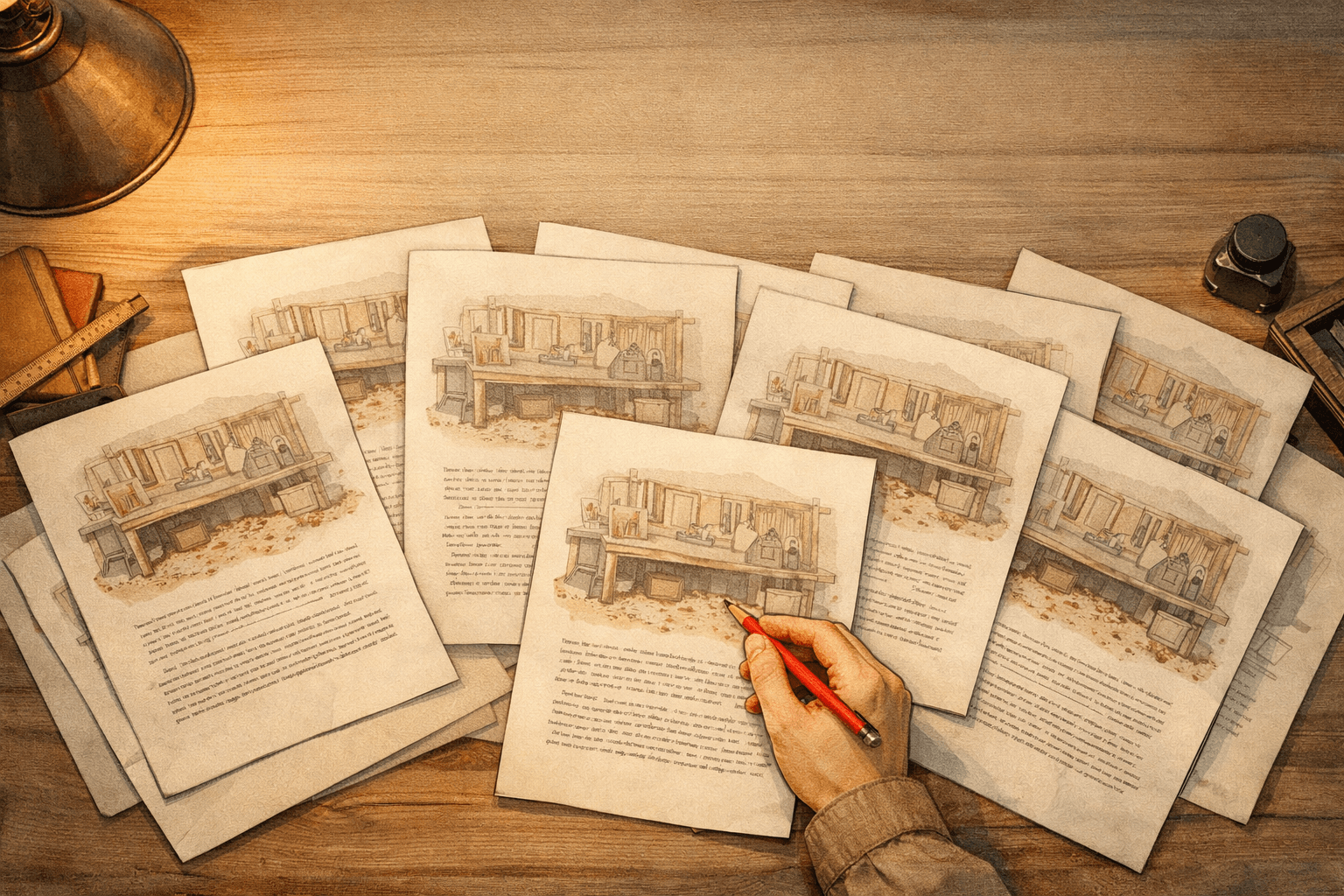
Chapter 1, she walks into the workshop. The smell of sawdust fills the air. Chapter 8, she's back. Sawdust again. Chapter 14, same workshop, same sawdust, same sentence you didn't realize you'd already written twice. The AI didn't remember. You didn't catch it. Your reader will.
The Problem Nobody Talks About
AI writing assistants have a memory problem that most writers misdiagnose. They blame their prompts. They tweak their instructions. They rewrite their system messages for the fifteenth time. None of it helps, because the issue isn't the prompt. It's the context window.
Every time you start a new chapter, your AI assistant starts fresh alongside you. It doesn't see chapter 3 while you're writing chapter 12. It can't flag that you've already described the apartment as "small but tidy" four times. You reach for the most natural detail for the scene, and without a system tracking what you've already used, that detail is almost always the same one you reached for last time.
This isn't a bug in the AI. It's a structural limitation. And it produces prose that self-plagiarizes in ways that are nearly invisible until you read the whole draft at once.
Where It Hits Hardest
The repetition clusters in three categories.
Recurring settings. Any location your characters visit more than once gets the same atmospheric details every time. The workshop smells like sawdust. The apartment has morning light streaming through the blinds. The café is always bustling. The AI picks the most plausible sensory detail and deploys it on repeat.
Character physicality. Your protagonist runs her fingers through her hair when she's nervous. Every time. Another character always cradles his coffee mug with both hands. These are fine details individually. They become tics when they show up unchanged across twenty chapters.
Static motifs. Thematic imagery that should evolve over the course of a manuscript stays frozen instead. The signal the character hears as an intrusion in chapter 1 should feel familiar by chapter 8 and comforting by chapter 20. Without memory of how the motif has been deployed before, the AI treats every occurrence as the first one.
The Fix Isn't a Better Prompt. It's a Registry.
The solution is a description registry: a running log, per project, that tracks what imagery has been used and how often. It's simple. It tracks three things:
What was used. The specific description, image, or detail.
How many times. A count that updates as you write.
Whether it's retired. Once a description hits three uses, it goes on the retired list. The AI is explicitly told: do not use these again.
You can build this as a spreadsheet, a notes document, or a structured file that feeds into your AI's context. The format matters less than the discipline. The point is to give your AI something it doesn't have by default: a memory of its own prose.
The retired list is the key mechanism. A retired description isn't a bad description. It's just done. It served its purpose. Forcing it off the table pushes the AI (and you) toward variety without requiring you to manually track every metaphor across a 90,000-word manuscript.
Optional upgrade: add a "freshness bank," a list of alternative descriptions waiting to be deployed. Instead of just telling the AI what not to write, you give it pre-approved options for what to write instead.
Turn the Bug Into a Feature
Here's where it gets interesting. Some imagery should recur. That's not repetition, that's craft. The difference between recurrence and repetition is intent.
A motif registry handles this by tracking evolution stages. Take that signal your character keeps hearing. The registry doesn't just log "signal, used 4 times, retire." It logs the progression:
Chapter 1: intrusive, startling
Chapter 8: familiar, background noise
Chapter 15: expected, almost missed when absent
Chapter 20: comforting, a sign of home
Now when the AI reviews chapter 15, it knows which version of the motif belongs there. The same image, at different temperatures. This is what good novelists do instinctively across months of writing. A registry lets you do it systematically across an afternoon of drafting.
What This Actually Gets You
Prose that reads like it was written by someone who remembers their own book. Settings that feel lived-in because they're described differently on the third visit than the first. Characters whose physical habits shift as they change. Motifs that develop instead of stagnate.
The real reframe is this: most writers treat AI repetition as a prompting failure. It's not. It's a systems problem. Better prompts won't fix an architecture that forgets everything between sessions. A registry will.
You don't need to build anything complicated. You need a list, a count, and a rule. Three uses and you're out. Start there. Your chapter-14 sawdust problem disappears.