
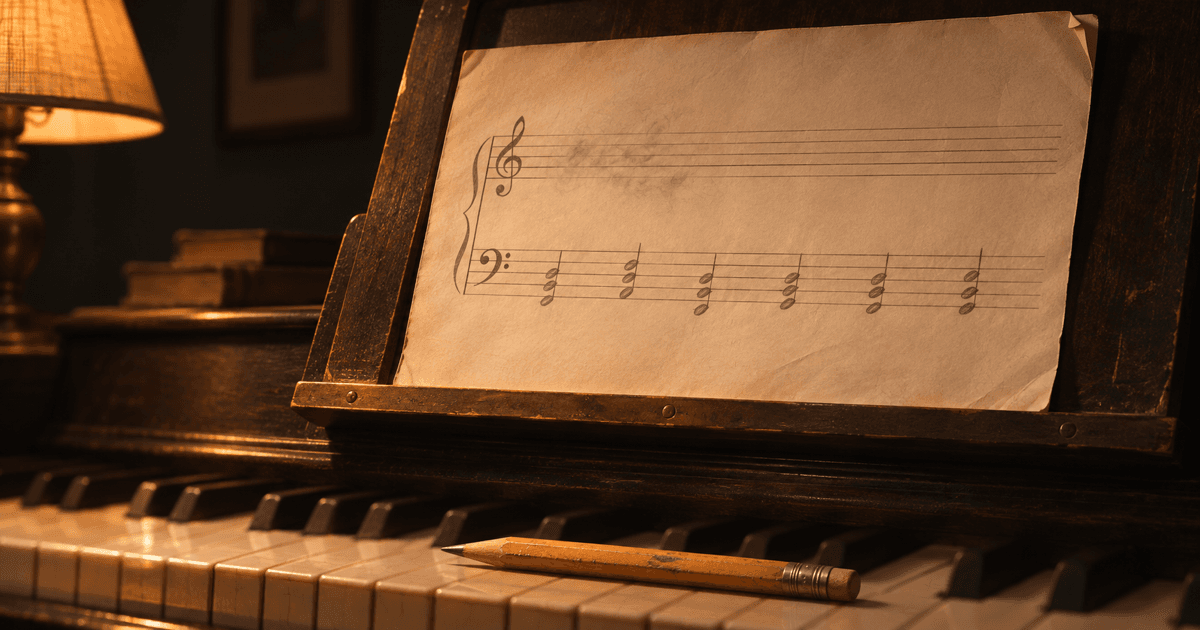
I can play "Easy" by the Commodores. Not concert-ready, but my hands know where it goes. So when I wanted to find out what my AI assistant could actually do with music, that was the obvious test. Write me a solo piano arrangement of "Easy." From memory. No looking it up.
I didn't listen to it alone. I set it up blind: three clips, shuffled, rated one to ten on a single question, "would I build on this?" One clip was an original ballad the AI wrote for the test. One was the AI's "Easy." The third was a control, the opening of a John Field nocturne from the early 1800s, written by a human who knew exactly what he was doing.
My scores: 8 for the AI original, 7 for the AI's "Easy," 5 for John Field.
And I didn't recognize "Easy." A song I play, in its own key, at its own tempo, with its rolling twelve-eight feel, and it went right past me. I heard three originals and none of them were bad.
Everything passed
Here's the part that stuck.
Before I heard a note, the arrangement went through a checker. Does it render. Is it the right length. Are 95% of the notes in the key (99.2% were). Can two human hands reach every chord. No melody leaps wider than an octave. No parallel fifths between the melody and the bass. Do the notes actually spell the chords they claim to be. The first pass caught one set of parallel octaves, the revision fixed it, and the final result was a clean PASS across the board.
Then, after the arrangement was locked, the system pulled two published chord charts and scored itself against them. One bar out of eighteen was right.
The AI had remembered the progression as I, iii, IV, I. The song is I, iii, ii, V. It had the first half and lost the turnaround, and the turnaround is the whole song. It also had the chords changing half as often as they really do. Key, tempo and feel were right. The song wasn't there.
Every check came back green, and the one fact that mattered sat outside all of them. The checker could confirm the music was competent piano writing. It had no way to confirm it was "Easy." That question can only be answered by something that already knows "Easy," and the only thing in the room that knew it was me.
The audition
Round two used the real chords from the published charts, with the melody written from memory again. This time I knew it on the first listen. When I was asked why, the answer was obvious: the chord progression.
That should have been the win. It was close enough that I could hear the shape, and I almost let it count.
Then I asked a sharper question. If I walked into an audition for a Commodores cover band and played this, would I get the gig?
No. The chords were right and the melody was invented to fit them. It's a plausible tune that sits on the correct harmony and never lands on the actual notes. Anyone who has sung along to that record in a car would hear it in two bars.
That's the cleanest picture I've found of what these systems are good and bad at. Writing in a style is cheap now. The original ballad got my highest score, and I meant it. Recalling one specific thing, exactly, is where it gets slippery, and the failure doesn't announce itself. It doesn't come back as noise. It comes back fluent, in the right key, passing every test that can be written down.
(To be fair to John Field: his clip was the only one played back with zero human timing, straight off the engraved notes. My note on it was "dry and calculated." That's a verdict on the playback, not the composition.)
The question that wandered
There's a quieter thing that happened in round two, and I almost missed it.
Round two also tested "humanization," the small timing and volume wobbles that make a MIDI file sound less like a machine. Same notes, two renders, one flat and one loosened up. I said they sounded pretty similar. That kicked off a careful measurement report on why: the timing jitter was 17 milliseconds, under what a listener notices, and the phrase endings only stretched by about 3%. A stronger round was already being lined up.
All of it was accurate. None of it was what I'd asked.
I hadn't set out to learn about MIDI time feel. I wanted to know whether the machine could give me a specific song. The work drifted toward the question it could measure, because timing in milliseconds has a ruler and "is this the melody" doesn't. Every step made sense from inside the step. I had to stop and say it out loud: this isn't the thing, put it down.
That's the same failure as the checker, one level up. The checker tested what could be tested and passed. The research pursued what could be measured and kept going. In both cases the real question sat just outside the instruments, and it took a person to notice it was missing.
What I'm keeping
I've been arguing on this site that AI does the work and I do the noticing. This test gave that a concrete shape.
The machine is good at plausible. Plausible passes checkers, because checkers measure the properties of good work in general. What it can't supply is recognition: the knowledge that this exact thing is or isn't the thing. That knowledge lives in the person who already loves the song, has played it, has heard it a few hundred times. It isn't a rule I can hand over. It's a memory, and it's mine.
So the test that matters most is the one I can't automate. Not "does it sound good," which the machine can increasingly fake, but "is it the one," which only someone who knows the one can answer. If I'm the only person in the loop who has heard the original, then I'm the checker. Everything else is just making sure the fake is well built.