
I've been carrying one question around this season: what's the most realistic way for me to get paid for telling stories with sound? Last week I handed it to my agents and asked for evidence instead of encouragement.
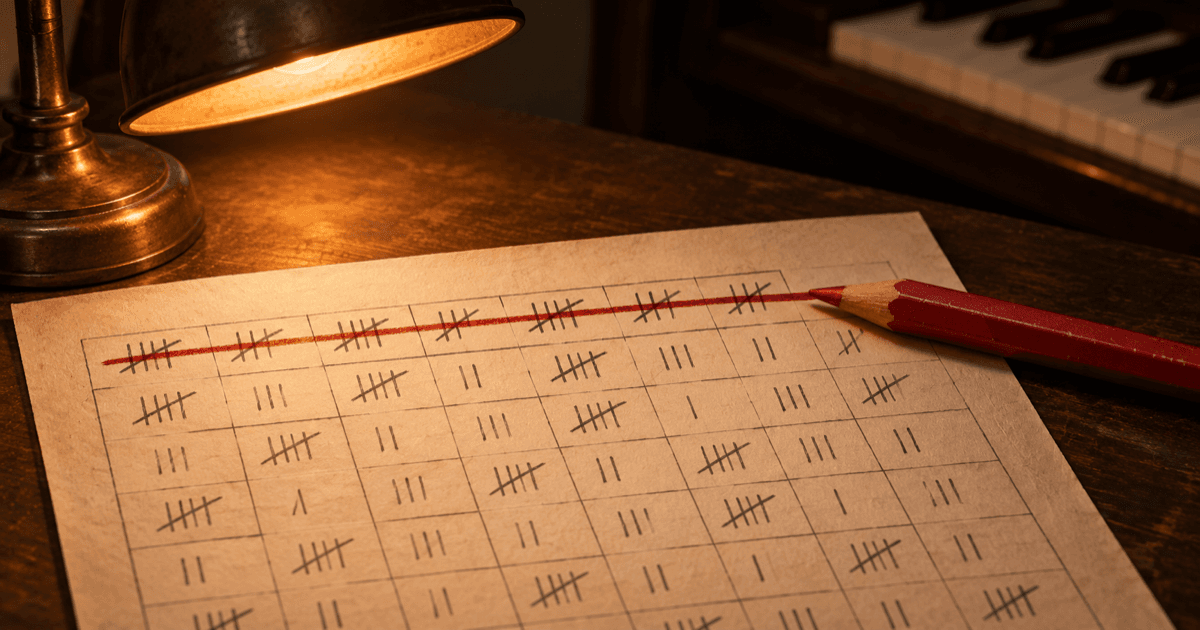
They came back with twelve paths on a scoreboard. Each one got a score from one to five on pay, fit, speed, cost, and whether I could test it in 30 days of nights and weekends. A path counted as proven only with two named people earning from it, real pay figures, and sources from 2025 or 2026.
The winner scored 23 out of 25: custom sleep stories and meditations, sold direct. Nine named sellers. A median price of $144.50. A complete experiment came with it: three samples in my own voice over my own piano, an offer page at $97 and $150, twenty direct messages to practitioners and coaches, and a pass line of one paid order by the end of November.
On paper it was hard to argue with. I read it and said no.
What the sheet couldn't hold
My objection was short. I have no psych background. If I were buying audio for somebody's sleep or somebody's anxiety, I'd want the person who made it to know something real about those things, and I wouldn't pick me. The plan also ran on my speaking voice, an idea I floated on this site last week and have since ruled out.
None of that touched the evidence. The sellers exist and the prices are real. The research even flagged its own gap: it proved what people charge, not how much they sell. There was no mistake for me to point at.
Here's the part I keep returning to. Fit, on that winning row, scored a 5.
That number was mine. Days earlier I'd told the system I leaned toward custom audio for hypnotherapists and meditation practitioners, and it wrote that down faithfully. The column recorded what I'd said. What I'd said was an idea I liked the sound of, and I only found out how little I meant it when it showed up with a price on it and twenty people to message.
So the failure wasn't the machine's, exactly. I gave it a preference I had never tested, and it gave me back a very well-supported version of that preference.
Why a column is the wrong shape
The number that bothers me most is one I worked out afterward. Knock fit all the way down to 1 and that row still totals 19. That's one point behind the new leader and ahead of nine of the other eleven paths.
Addition lets things trade. Good pay evidence, a fast first dollar, and a cheap setup can buy back almost any amount of "I don't want to be this person." A weighted total has no way to say no. It can only say less.
Judgment doesn't behave like that. When I said "I am not a puppet" before the second run, I wasn't offering a low score to average in. I was saying a whole category of work was off the table, whatever it paid.
So round two was built differently. Fit became a gate, checked first: music or my own writing at the core, no narration by me, nothing fake, no credential I lack, and something I could plausibly make for a year unpaid. Sleep stories, practitioner audio, and narrated channels each got one line and no score. Nobody counted their money, because nobody needed to.
The ranking rule changed too. Passing the gates now outranks the total, which is how a path scoring 14 sits above a path scoring 20. That looks wrong until the job of the number is clear. The number sorts what's left. It doesn't decide what's allowed in.
What the gate didn't fix
A gate isn't an answer. The top path after round two was tabletop RPG music, and its proof is thin: every Patreon figure behind it comes from a tracker's estimate. I like that path better. That tells me nothing about whether it pays.
Two rounds also taught me something less flattering about the question itself. Nothing about "how do I get paid for this" can be checked inside two weeks, so the research kept returning advice I could have guessed. I've since demoted it to a compass and started asking smaller questions with a result I can read on a date.
And I have to be honest about how the gate got written. I couldn't have written it before the first run. I'd have listed "fit" and called it a 5, which is effectively what happened. The criteria came from flinching at a specific offer page with specific prices on it.
That's the piece of this I'd carry into other work. I've been arguing that AI does the work and I do the noticing, and it's tempting to read that as me standing above the machine, inspecting its output with a trained eye. This was less dignified. My stated preferences were wrong. My reaction to a concrete proposal was right. I needed the fully built bad idea, argued as well as it could be argued, before I could find out what I actually thought.
So the 23 did its job, just not the one on the label. It gave my no something to push against. Then the no had to go somewhere the total couldn't reach it, because anything I put in the column, the column will eventually outvote.